
Flow past a tree
My contribution to the Plantenna research project consistent of the development of numerical methods that can be used to numerically characterize the drag forces exerted by trees on atmospheric winds. For thus purpose, a simplified fractal model was developed, where trees consist of cylindrical branches. As an initial test of the methods, the well-characterized flow around a cylinder was studied first.
After validation of the methods, flows passing fractal trees could be studied. The movie below also highlights the adaptive mesh focusing on the shedding of the boundary layers, which results in the turbulent wake.
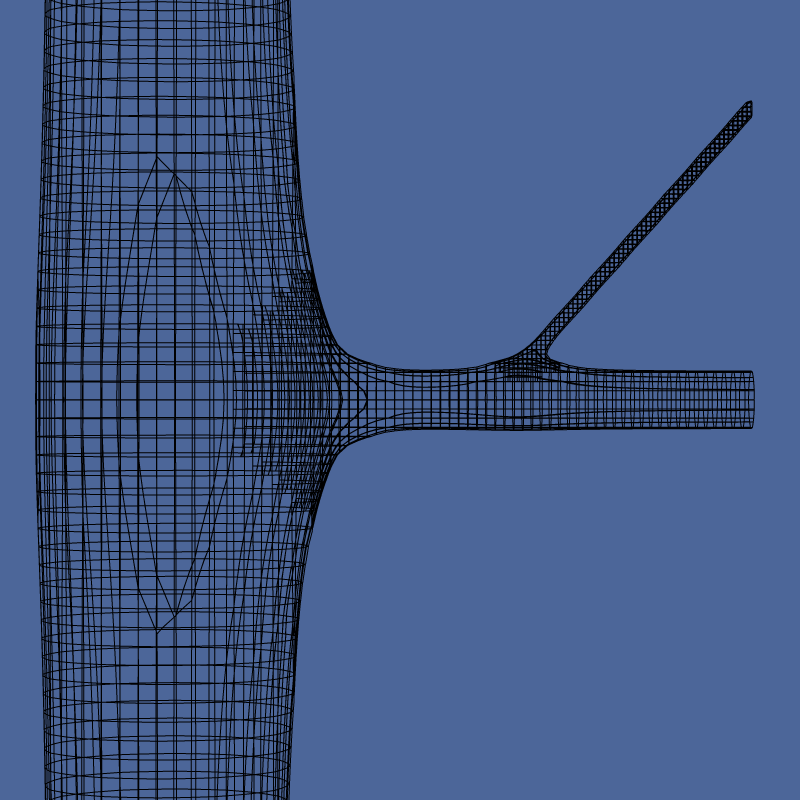
Bonus: Meshing a range of branch radii
For the feasibility of such simulations, optimal meshing is required. From boundary-layer theory it can be derived that smaller-diameter branches require less (in total), but finer cells. As such, a curvature-based refinement was developed and employed.
Reference
Jeong, J., & Hussain, F. (1995). On the identification of a vortex. Journal of fluid mechanics, 285, 69-94.↩︎