
A dipolar vortex near a sharp-edged boundary
This page concerns the topic of my master thesis project1: A dipolar vortex colliding with a sharp-edged wall. A movie from the rotating laboratory experiments is shown below.
During the thesis project I also numerically modeled this scenario using COMSOL. However, I did redo these simulations later using Basilisk. You can see the results for dipoles with varying initial trajectories below.
The shallow viscous boundary layers require a high-resolution mesh. In order to efficiently model this an adaptive grid was used. You can see the evolution of this mesh structure below.
Bonus: Point-vortex model
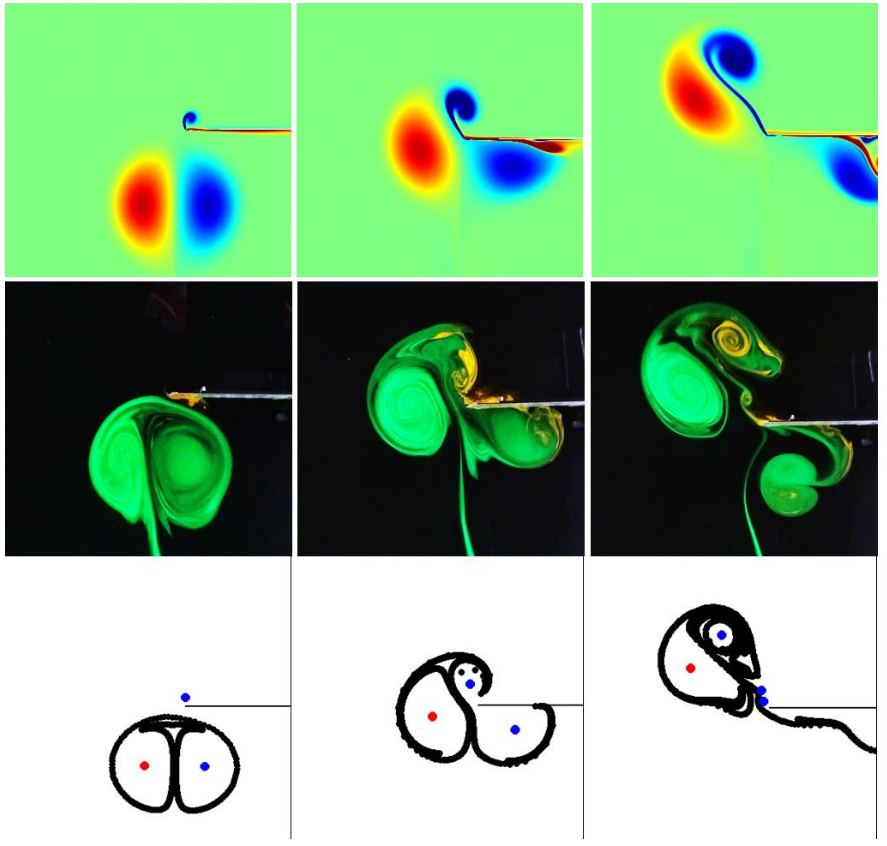
Aside from studying the dynamics in a lab and with direct numerical simulation, it can be useful to synthesize the gained insights and attempt to describe physics with a conceptual model. For this project, we extended a point-vortex model with a “mirror-images” wall and conformal mapping to add a sharp-edged wall to the flow. The generation of the secondary vorticity was described by satisfying the so-called “Kutta condition”, i.e. the sharp edge is a stagnation point. A satisfactory result is shown below.
Reference
van Hooft, J.A. The Dynamical Behavior of a Dipolar Vortex near Sharp-Edged Boundaries, TU/e Msc thesis (2015)↩︎