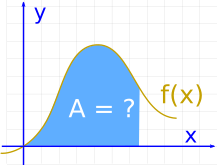
Is the area under a curve a topic of
single variable calculus? Image by mathisfun.com
Consider the Cartesian
plane. The area
of some surface
()
may be computed as integral of infinitely small surface elements
,
Lets say we want to compute the surface area of the blue-shaded area
in the figure. This area is bound by the function
and
for
.
We can write
This results corresponds to what you already knew from your
single-variable Calculus course.
Thank you multiple integration! for degenerating into single-variable
calculus in this limit.
Week 6B: Work done by a
force field
Consider a particle moving in a circular trajectory with radius
,
angular frequency
,
and time parameter
,
It is affected by a force field
()
given by,
We can compute the work
()
done on this particle during a single rotation as the line integral of
infinitely small work sections
.
Because we know we want to integrate force over a distance, it would be
nice if we could integrate over the displaced (from 0 to
).
As such we look for the paramterization in terms of its intrinsic
parameter (i.e. path length). For this simple paramterization, we can
rewrite the coordinate
as a function of time into a function of the traveled distance
(),
such that
.
Fortunately there is a simple invertible relation
,
and its inverse,
Such that
So for the work we may write,
With
the (unit) tangential vector and not to be confused with the time
parameter
(),
Such that the inner product
We know from the parameterization
.
Thus,
Resulting in the integral,
Thank you line integral, I guess. But isn’t there an easier way?