
A visualization of a record-setting turbulence simulation
The Johns Hopkins turbulence database updates every now and then with new simulation data of turbulence. Recently a simulation of isotropic turbulence modeled with grid points was added. I downloaded a slice of velocity data and converted it to the RGB channels () of the pixels in a image. Following the methodology of the Mandelbrot set blog post below, you can inspect the 1 Gigapixel image below.
The result looks OK, but given the high amount of saturated color data, I should have scaled the velocity components a bit differently.
A Mandelbrot set visualization of 64 Gigapixel
You may pan and zoom as you would with Google Maps. Enjoy!
The image viewer is a javascript plugin by the Open Seadragon project. These “deep zoom” images were generated using libvips, from the original (very large) color-code images which were computed using Basilisk on an adaptive quadtree grid, as described here.
When I was looking up other large Mandelbrot images for comparison, I found this one by Silversky. This source allows for far deeper enlargements by letting you render the images as you zoom. Which is likely a better idea compared to loading pre-rendered images. They do however use a low number of “maximum iterations” (I guess a few 100) compared to “my” image (using 4000).
Schamelaar
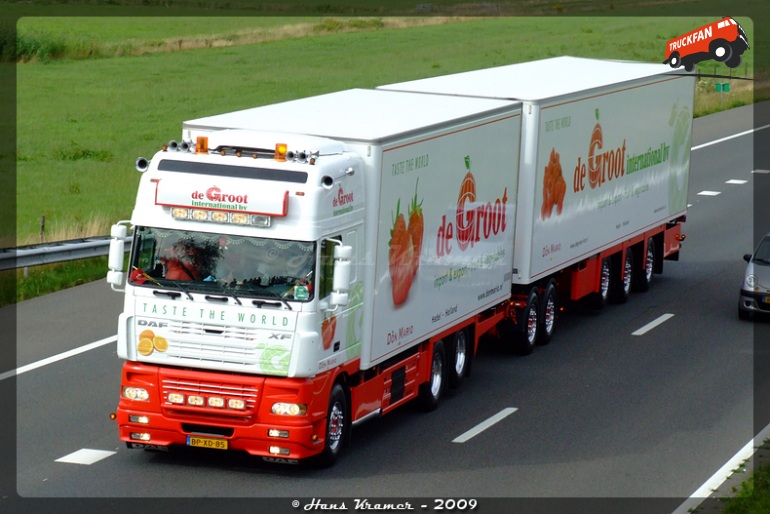
When I was 18 years old, I worked in the weekends at a warehouse for fruits and vegetables. The driver of the truck pictured above (“Lange Toon”) would regularly impress me, by bringing the double-hinged trailer to the dock. I wrote a simple “game” (called schamelaar) to practice maneuvering such double-hinged combinations. Use the arrow keys to drive and you may alter the dimensions of trailer by pressing 1,2,3 and 4. Goodluck!
An adaptive hybrid Eulerian-Lagrangian flow solver
I extended the adaptive dual grid flow solver with a Lagrangian component: The vorticity field () is represented with a point set, whose locations can be advected by a flow field. In order to maintain an accurate and efficient representation of the field, it may be required to add or remove particles (perhaps near stagnation points). See for example the results from the Taylor-Green vortex test case, where the code attempt to maintain a constant resolution over the domain.
The obligatory convergence study shows good convergence on average but the maximum error is not very well behaved.

The next step is to add adaptivity. This aspect is well illustrated by the results from a mode-3 vortex instability study (tip: view full screen).
It appears that the advantages of Lagrangian advection can be combined with the efficient solving of the Poisson problem on a seperately adapted Eulerian grid.